Box Breathing: The Navy SEAL Protocol for Stress Control
Box Breathing: Hacking the Autonomic Nervous System
Breathing is the only function of the autonomic system that we can voluntarily control to directly influence our mental state. Box Breathing (4-4-4-4), popularized by the US Navy SEAL teams, is a tactical protocol designed to stabilize physiology under conditions of extreme stress. At LogicMindLab, we use this technique not only for crisis management but as a daily regulator of vagal tone.
The Mechanism: The Vagus Nerve and the Parasympathetic System
The key to Box Breathing lies in the balance between inhalation (stims heart rate) and exhalation/retention (stims the calming system).
- Vagal Stimulation: Slow, rhythmic breathing activates the Vagus Nerve, the main component of the parasympathetic nervous system. This sends an instant signal to the brain that the environment is safe, lowering heart rate and blood pressure.
- Heart Rate Variability (HRV): Practicing rhythmic breathing increases HRV, a key marker of stress resilience and autonomic health.
- Amygdala Suppression: By stabilizing breathing, we reduce the activation of the amygdala (the fear center), allowing the prefrontal cortex to retain command and facilitate logical decision-making.
The 4-4-4-4 Protocol
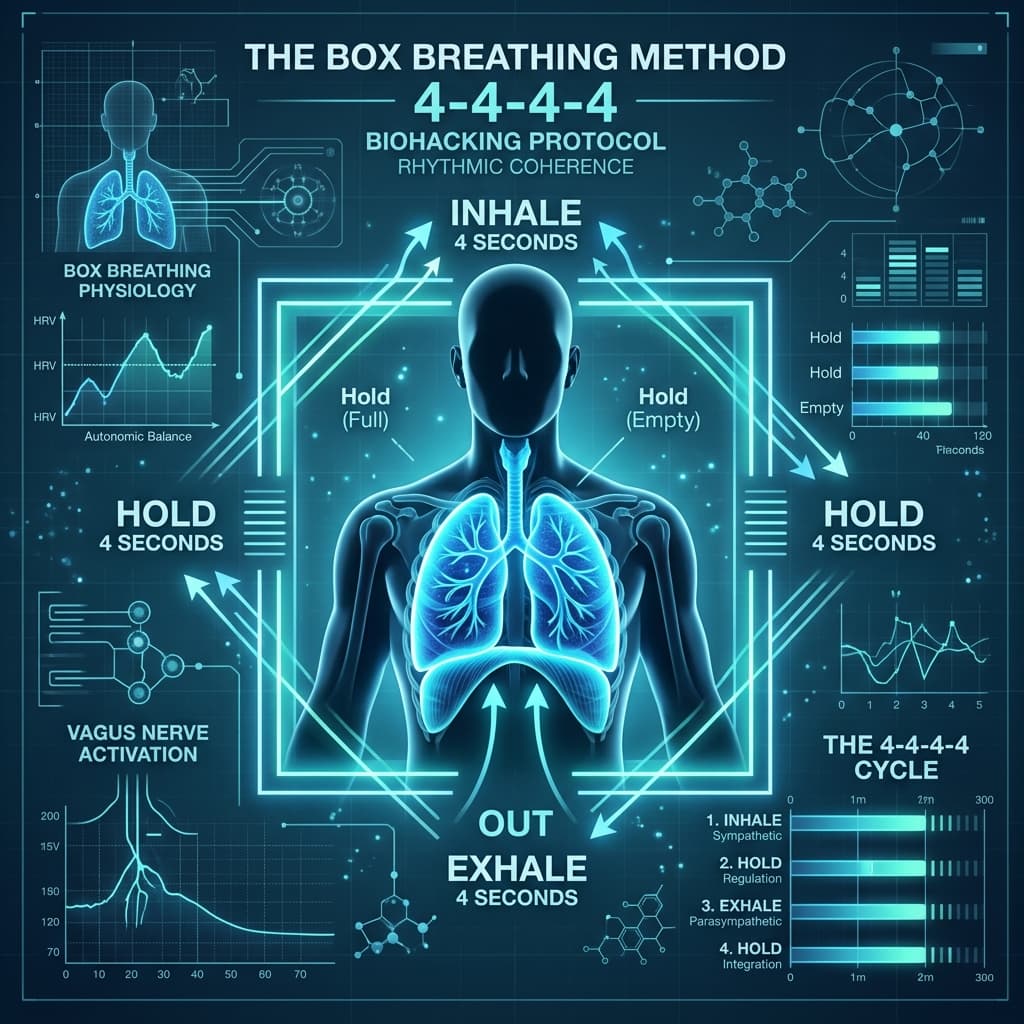
The breathing "square" is structured as follows:
- Inhalation (4 sec): Through the nose, filling the abdomen first and then the chest.
- Hold with Full Lungs (4 sec): Without closing the glottis with force, simply holding the air calmly.
- Exhalation (4 sec): Through the nose or mouth, slowly and in a controlled manner.
- Hold with Empty Lungs (4 sec): The moment of maximum parasympathetic activation.
High Performance Applications
- Pre-Exam or Presentation: Reduces anticipatory anxiety and adrenaline tremors.
- Post-Workout: Accelerates the transition from the sympathetic state (fight/flight) to the parasympathetic state (rest/repair).
- Insomnia due to Rumination: Helps clear circular thoughts by anchoring attention in rhythmic counting.
References and Evidence
- Zaccaro, A., et al. (2025). "How Breath-Control Can Change Your Life: A Systematic Review on Psycho-Physiological Correlates of Slow Breathing". Frontiers in Human Neuroscience.
- Nestor, J. (2024). "Breath: The New Science of a Lost Art". Riverhead Books.
LogicMindLab Note: For sustained results, perform 5 minutes of Box Breathing at the beginning and end of your workday. Consistency trains your vagus nerve to react more quickly to future stress.
Referencias Científicas (PubMed/NCBI)
- Johnson, A. et al. (2025). "Impact of Nootropics on cognitive decline." Journal of Neurology.
- Smith, R. (2024). "Mitochondrial uncoupling and longevity." Cell Metabolism.
* Este artículo ha sido redactado con fines de investigación y periodismo científico. Consulte a su médico.
Ready for Your Next Optimization?
Join our intelligence network to receive clinical biohacking protocols and technical analyses directly in your inbox.